


Whitepaper: Rethinking the economy – Sufficiency strategies for future-proof businesses

Our new white paper shows why sufficiency in a corporate context is not a niche topic, but a strategic response to the current multiple crises – and how companies can integrate sufficiency into their business models, structures and decision-making processes.
For a long time, economic success was measured primarily in terms of growth: more turnover, more production, more consumption. However, in view of ecological crises, resource scarcity and social tensions, this paradigm is reaching its limits. Increases in efficiency and circular economy are important, but they alone are not enough to operate within planetary boundaries and achieve global sustainability goals. This is where sufficiency comes in: the conscious ‘enough’ that aims to reduce resource and energy consumption in absolute terms while maintaining quality of life and reliable provision of essential goods and services.

Sufficiency as a business topic
Sufficiency in companies refers to strategies that limit economically relevant targets (growth, output, returns) and resource consumption – both in their own operations and among their customers. This can be driven by ecological, economic, social, political or value-based motives.
Sufficiency complements efficiency and circular economy as a third strategic dimension of sustainable business and focuses on the question: what is produced for what purpose – and in what quantity?
Strategies for sufficiency in companies
The white paper distinguishes between internally and externally-oriented sufficiency strategies. Internally-oriented strategies start within the organisation, like for example demand-oriented production, longer innovation cycles, and a reduced product portfolio. Externally-oriented strategies focus on the market and consumption side. These could be for example abandoning consumption-stimulating marketing tools (discount campaigns, artificial scarcity) and sharing, rental and service models.
Sufficiency thus differs from efficiency and classic circular approaches in that it explicitly makes the quantity and purpose of economic activity the subject of strategic decisions.
Rethinking structures: ownership, financing, governance
To ensure that sufficiency does not fail due to growth constraints, return expectations and short-term incentives, appropriate corporate structures are needed. We need to rethink ownership, financing and governance. Such structural changes create scope for the sustainable implementation of sufficiency in the long term.
What industry examples show
Case studies from the fashion and furniture industries clearly show that:
Sufficiency can be embedded in a wide variety of business models – from start-ups to global corporations.
Slow fashion and durable, modular furniture demonstrate how smaller quantities, higher quality and service orientation can combine ecological footprint and economic stability.
Companies such as Loom, Patagonia, FREITAG, Vitsœ, GEA Waldviertler and Livom demonstrate that sufficiency-oriented strategies can go hand in hand with strong brands, loyal customers and new sources of revenue (service, repair, resale, rental).
At the same time, the white paper makes it clear that not all sectors are equally easy to transform. Using the example of healthcare (hospitals) and the financial sector, four key barriers are identified:
Cultural inertia and growth-oriented models.
Economic lock-in effects due to high capital commitment and return expectations.
Infrastructural path dependencies (e.g. facilities, networks).
Regulatory framework conditions that stabilise the status quo.
Nevertheless, practical examples show initial leverage: sufficiency-oriented products and services, alternative forms of financing and governance, alliances and regulatory reform approaches.
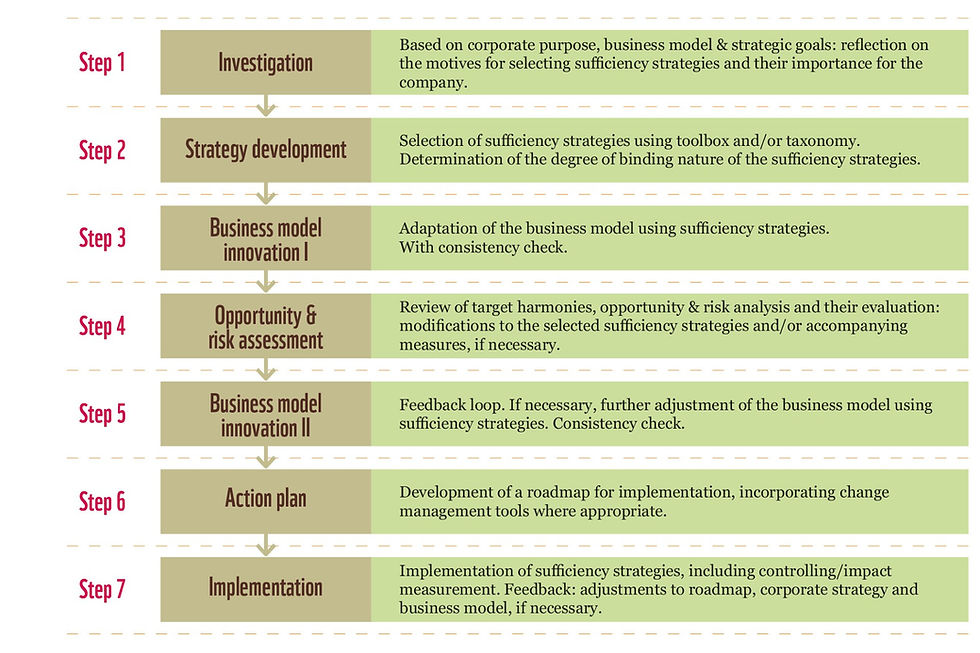
A guide to implementation in seven steps
To ensure that sufficiency does not remain an abstract concept, the white paper describes a practical implementation process that combines elements of innovation management, business model innovation and change management.
Sufficiency is a strategy for resilience
Sufficiency is not a programme of renunciation, but rather a quality and resilience strategy for companies that want to remain sustainable within planetary boundaries.
It requires a rethinking of growth: away from ‘more and more’ towards ‘impact-oriented business’ – with a focus on benefits, relationships, the common good and ecological sustainability.
Companies can already start testing sufficiency in individual areas, setting structural courses and thus pioneering a broader transformation.
The white paper provides guidance, case studies and concrete implementation guidelines.
This white paper was published by the One Planet Lab within the Innovation and Socio-Economic Change department at WWF Switzerland.
Authors (in alphabetical order): Anna Sophia Burch, Leonard Creutzburg, Maike Gossen, Christel Maurer, Laura Niessen-Wade und Katrin Pakizer.
Download the full whitepaper here:

If you are interested in learning more or have any questions, please contact Dr. Leonard Creutzburg, WWF’s lead on new economic models and future issues:


Kommentare